Tuesday, December 27, 2011

Conservation: A word or two about tree-hugging...

It is quite unfortunate the meaning of the word "conservation" gets lost in the politics surrounding it. 

Conservation, from a physics and engineering standpoint is best understood in terms of the physical laws you likely don’t remember learning about in high-school. Specifically, I am referring to the law of conservation of mass-energy, which states (somewhat simplified) that for a closed system the amount of mass and energy remains constant. 

In other words, if I had a completely sealed, perfectly insulated box full of 5 pounds of Hydrogen and Oxygen, and then combined them to form water, I would have exactly 5 pounds of water. No additional mass would be created (The fellow in the image on the left is Antoine Lavoisier. He performed essentially that experiment) .

Or let’s say the sealed, insulated box contains nothing other than a hamster wheel, spinning a certain number of revolutions per second. Now, if there is no friction, then the hamster wheel will spin indefinitely (another conservation law – conservation of momentum is at play). The hamster wheel in this case has mass, and kinetic (or motion) energy. If there is friction, then it will slow down, as the kinetic energy from the spinning wheel is converted to heat energy. The temperature in the box will rise, and when the wheel stops, there will be an amount of heat energy equal to the amount of kinetic energy the wheel had at the beginning. Motion energy was converted to heat energy - Conservation.

Consider the earth then. Where mass is concerned, Earth is very nearly a closed system. Sure, we get the occasional bit of mass added in the form of a meteor, or similar space object, and we shoot small amounts of mass from earth to space in the form of rockets and satellites. But relative to the size of the earth, those little bits in and out are miniscule.

Earth is not a closed system with respect to energy. We absorb energy from the Sun. We release heat into space. The gravitational pull of the sun and the moon on the ocean (tides) also adds energy.

Are you glazed over and drooling in your lap yet? The worst is over (maybe). Here on earth, everything else that happens is within that context. We humans don’t really create stuff, (or destroy stuff). We simply convert stuff. Take a tree. Add a little labor to chop it up, and you get lumber. Grind it to itty-bitty pieces, and it is sawdust. Grind it up further, mix with water, flatten and dry and the tree becomes a piece of paper. That is all we do really; utilize stuff and energy to make different stuff.

So real conservation is at its root, about maintaining a… a balanced budget, if you will. It is about making sure we aren’t using more energy than we can practically create, and that we aren’t converting the mass from something useful to something useless faster than we can convert the useless mass back to useful mass.

A true conservationist is concerned about the use of fossil fuel, because it took an incredibly long time to make that fuel, we simply cannot create it as fast as we can consume it. Nuclear power carries a similar concern. There is a limited amount of radioactive material on the planet, and the energy creation process converts it to a material we don’t have a practical use for, which will remain potentially un-useful for thousands or even tens of thousands of years. It would probably be a good idea to get away from using such things as consumables, and focus their use on longer term outputs (for example, oil can be used for manufacturing plastics. Not the disposable stuff - trash bag and such - but things with longevity, like fencing, or siding for houses). And when it comes to energy, we should probably focus our attention on sources which are rapidly renewable (solar, wind, wave, geothermal, hydrogen...).

Of course, there are more complicated considerations. Consider coffee, as an example. In the past 20 years, coffee growers have selectively bred coffee plants which can grow well in full sun. This has allowed them to remove the forestation which used to provide protection for the coffee plants (which naturally preferred shade), allowing them to increase production levels. This is an economically desirable move, as it allows for an increase in supply to meet the ever growing demand.

This has however required them to use chemical fertilizers, pesticides, herbicides,  etc… which were not needed before. The Tall forest and the ecosystem associated with it provided the protection from pests and nutrients to the soil. With this ecosystem gone, it is necessary to provide that protection and nutrition via artificial means. (As a side note: Many of these consumables contain components derived from fossil fuels, I have already suggested that is probably not a good idea.).

This production method is also eliminating habitat for migratory birds (and other critters) that inhabit the forest canopy.  Now, I suppose you could argue that this is simply survival of the fittest. Adapt and evolve or die. But adaptation, evolution requires biodiversity. Eliminating entire species reduces the available diversity.  This is probably not a good idea (Think “inbreeding”).

Additionally, if an entire species is wiped out, we may lose access to potential benefits as yet undiscovered. Who knows what plant or critter might be the source of new knowledge, or life-saving medicine? (For an example, see Curing Lessons Learned from Plants. )

 Conservation shouldn’t get lost in political maneuvering, or extremist positions. It should really be a very scientific, measured process. How much do we consume? How quickly can we recycle the exhaust products? Are the required inputs (both mass and energy) created at a greater rate than we are consuming them? This generally gets ignored by business plans, which are generally not concerned with long term viability, compared to short term margin growth. And the nuts on the other side of the fence, romanticizing about wolves, blowing up fur factories, vandalizing mink farms and the like certainly aren’t helping the cause.

But somewhere in the middle of all the business, politics, and red-necked rebelliousness and bunny-hugging nuttiness, is a rational point of conservation common sense. It would sure be nice to get there.

Resources:


Saturday, December 10, 2011

Preventng the Zombie Apocalypse

I love this commercial...


 First of all, it has zombies, and hey, what geek doesn’t like zombies? Nearly every geek at one time or another has dreamed about waking up to the zombie apocalypse, and an endless supply of firepower.


(usually there is a pretty girl in a with a magic sword involved too… I know… kinda random… It’s a geek thing…)


 (Usually they are less modest in their clothing choice too, which  never really made sense to me because, hello... Flesh eating zombie horde... You're seriously going without armor?)


However… I don’t think the girl is universal... not sure what the direct female geek counterpart is… somehow I doubt it is a smarmy guy in a short skirt… with or without the magic sword.


But the other, more philosophically deep reason for my appreciation of this commercial is for its moral about good design practice.

One of my favorite engineering instructors once told the class that engineers are in the "excitement avoidance" business. When you are designing a bridge that thousands of vehicles will travel across, your goal as a designer is to engineer that bridge such that every traversal of that bridge as excruciatingly uneventful as possible. When designing a rocket to go into space, you want it to do so as boringly as a rocket can. Good engineering means never having to make the news for a battery that doesn’t last or a murderous molasses flood.

It is difficult to practice good engineering. A lot of wisdom is required. You need to have a good deal of experience in order to be able to look into the future and see all the possible ‘what if?’s.
It is also difficult because of the compromise factor. Engineers have conflicting requirements. They are expected to build it safer than ever, faster than ever, and cheaper than ever, all at once. Good, Fast,  Cheap, as they say. 


When you get the balance wrong, bad things happen...


But when it goes right, it is amazing


So hats off to you, the few, the dedicated, the truly boring. May your days be filled with non-events, (and managers who listen), and may your dreams be replete with Zombie Domination (hot chick with magic sword optional).

Monday, November 28, 2011

The "1%" and "99%"revisited

I find it rather amusing that I keep getting goaded into defending the occupy (/99%) movement of late. Amusing, because I don’t actually approve of most of their aims, or their methods.

I suppose it is because I am not a fan of bullying, and most of the conversations I have become involved in are of that ilk:

“The lazy bums should get a job” – Over-generalization, while there are certainly many looking for handouts, some are sincerely concerned about real problems.

“Americans expect too much. US poverty level is $30k.” – Misleading. Poverty level depends on family size. It is $15k for a family of 2, $22k for a family of 3. It doesn’t hit $30 until you hit a 6 person family (Alaska and Hawaii are slightly different numbers).

“They are a bunch of rioters and rapists.” – While I don’t wish to downplay the specific incidents, they are just that – specific incidents. It is a gross over-generalization to judge the group by the actions of a few. By that measure, the Catholic church should be abolished, fraternities should be outlawed,… The responsible people should be punished, not the organization they belong to (unless of course the organization as a whole, or majority, shows a true propensity for fostering, supporting, or protecting such behavior. That certainly does not seem to be the case here).

“They are picking on the rich, trying to take their hard earned money unjustly.” – Again, certainly some are, (and the “99%” movement is guilty of over-generalization in targeting the “1%”). However making a brief review of the past decade or so: Enron, Worldcomm, Seimens, Exxon, FannieMae, Firestone, Refco, Waste Management, Qwest, Health South Corp., AOL/Time Warner, Disney, Lucent… There have been plenty of cases where wealth among the wealthy was increased, without being earned.  Perhaps most grievous are those like AIG, who received tax dollars to bail them out of their financial predicament, and as they were receiving tax dollars, the news reported layoffs in the lower ranks, executive retreats at posh resorts, and hundreds of millions in bonuses to the "talent" which likely got the company in this predicament, and are now avoiding responsibility for their risky behavior .

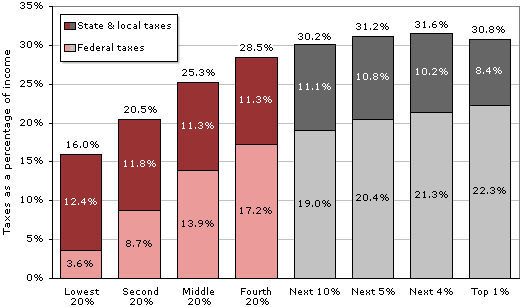
I discussed the tax situation in a previous blog post, and thus far, I have found no hard numbers which invalidate my estimations, or resulting calculations. In fact, I discovered the following graphic (from this article: a worthwhile read...) which makes the point much more clearly. It is worth noting however, that at present, the federal percentages follow a reasonable, moderately progressive curve, and it is taxation at the state level which appears to be the source of the disparity.It is looking as if this may change (for the worse) next year, as lawmakers appear to be prepared to allow a middle class tax-cut to expire.


However in spite of this, and in spite of the fact that I keep standing up for the "99%" when they get bad-mouthed, I support neither their motives, nor their methods.

First their methods: Camping out. What exactly do they hope to accomplish? I appreciate the whole solidarity – holding hands and singing kumbaya and all that. But what a waste of resources. They are warm bodies, taking up space, consuming resources (food, water), creating waste. And for what? A little media attention? 

Surely they can find a more effective, more efficient way to utilize the physical and mental resources at their disposal.

Here’s one idea. Perhaps they could camp out in DC, link arms around the congressional buildings, ensuring that lobbyists don’t get in, and congress critters don’t get out until a balanced budget is passed, and special interest spending is trimmed.


Or they could initiate a door to door information campaign, to get citizens actively involved in the democratic process, restoring the representative democracy that we are supposed to be.

This whole Arab spring look-alike bit is just impractical. While we may have problems, they are nowhere near the scale of the problems which have led those people to do what they are doing.

Now to motives: What are their motives exactly? Do they know? Are they able to identify a practical number of demands which they can all get behind and focus on? They seem to be all over the place. There are all kinds of proposed demands, and multiple lists. (http://www.buzzfeed.com/donnad/occupy-wallstreet-list-of-demands, https://sites.google.com/site/the99percentdeclaration/)

One of the above lists has over 20 demands, and includes among its topics, Internet Censorship, and Gender/Marriage legislation. Can you say "Random"?

Certainly, they have some good ideas among their demands, such as better separation between political and corporate interests, implementation of a fair tax code, sanctions against China to reign in currency manipulation, and the institution of a debt reduction plan. I think I could truly get behind those demands, were they the sole, agreed-upon list of demands of a focused, organized, acting effort.

The rest of the list ranges from the impractical (recalling all US military personnel worldwide, open borders migration…), to the irrational (guaranteed income regardless of unemployment , across the board debt forgiveness for all…). 

The US isn't an island, we interact with other cultures and ideals, we will of necessity have to to protect our ideals, that means a military force, and border monitoring. The planet is too small to practice isolationism today.

And get real. Nothing is free. If you want to eat, you've got to hunt/gather/farm. The government role in welfare should be to create jobs, not welfare victims. 

And when it comes to debt... hey, you spent more money than you had on crap you didn't need. An X-box is not a necessity, nor are movies, pro-sports events, 3D-TV's, cable subscriptions, SUV's, Cell Phones...


So, why do I keep sticking up for them? Disinformation, even for a just, is wrong. Certainly I can feel good about combating disinformation campaigns, but why does it always seem to end up with me "taking their side"? Why is it so hard to stay centered in the face of an extreme position?

Reminds me of an incident many decades ago, when as a high school junior, I stepped in to stop two big kids from beating up a little kid (probably 2nd and 3rd graders), No sooner was little kid on his feet, than he started smarting off to big kids. I found myself thinking “Maybe I should have just left it alone.”.

--------------------------------------------

 "Understanding is a three edged sword. Your side, my side and the truth that lies between"
  - Kosh Naranek

Saturday, November 26, 2011

Alton Brown is my new Hero


I have been a fan of Alton Brown since I discovered GoodEats. It’s like… cooking for geeks. It is loaded with all kinds of great geek humor. And he spends time explaining the chemistry behind the cooking. You don’t just get a recipe walk-through; you also get history, and deep, fundamental background as to how and why it works the way it does. It is the kind of information that can be applied to other cookery projects.

Alton Brown gave me the confidence to depart from just following recipes, and create my own culinary concoctions (Not that I am a cooking superstar. I am purely hobby, but I do enjoy the adventure).
 
And recently he became my hero.

With the potential Crohn’s diagnosis and the related symptoms came a rather drastic change in diet. When you eliminate all the potential Crohn’s triggers, you are basically left with chicken, turkey, fish (which is prohibitively expensive when you live in the middle of the mountains),  most fruits, lettuce, celery and yams. Pretty much everything else is a potential trigger. I went on this very restrictive diet in an effort to get symptoms under control, with the plan to reintroduce foods and monitor results, in order to determine what my specific triggers were.

Several weeks into this, I was having a particularly dreary day, specifically bemoaning the absence of pasta in my life. I love pasta. I’m not especially picky about it. I don’t care what the noodle is. Pasta is about the sauce. I love to make sauce. Mostly tomato based sauce. I could eat spaghetti two or three times a week. And this doing without pasta was cruel and unusual punishment in my book.

Anyway, on this particular day, I was feeling particularly sorry for myself over this when I sat down to watch an episode of Good Eats with summer squash as the subject. One of the recipes Alton presented was a "pasta salad", using Zucchini as the pasta. As he described how to accomplish this, and why it worked, a small spark of hope was ignited. Surely these Zucchini noodles could serve as the platform for pasta sauce as well. 

We happened to have a couple Zucchini, from the last Bountiful Baskets. So I talked my wife into giving it a try one night. After the peeling and salting, she rinsed them, and tossed them in the microwave for a few seconds to warm them up.  When I got home from work, they were plated and smothered in Sauce. It was darn close to Spaghetti, with a slightly thicker noodle. The texture was good. The Zucchini taste was present, complimentary, but not overpowering. My favorite food was back on the menu!

So Thank-you Alton Brown, for saving my spaghetti. You are my hero!

Sunday, November 13, 2011

Recipe: Turkey Breakfast Sausage

Diet  restrictions (Basically limited to poultry, fish, fruits, and veggies), led me to create this recipe so I can have a more enjoyable breakfast experience....

Turkey Breakfast Sausage

2.5 lb ground turkey
1 tsp ginger
1 3/4 t salt
1 1/14 tsp rubbed sage
1 1/2 tsp black pepper
1 1/2 tsp anise seed
1 tsp fennel seed

Combine spices, mix thoroughly into ground turkey.

Spread into an 8" square baking pan.

Bake at 350 degrees (F) to an internal temp of 160 degrees (F).

Drain grease (unless you want the extra calories, in which case, let it sit, and the turkey will soak most of it back up).

Cool sufficiently to handle, remove from pan, cut in half, then cut the halves into 1/2 to 3/4 inch strips (so your dimensions will be approx 4"x 1.5" x .5").

Freeze for later use. (I place a strip of wax paper between each, to prevent stick-age during freezing, and then wrap in butcher paper.

Reheat "links" in a frying pan and enjoy.

Saturday, November 5, 2011

Chicken Tomato Cabbage Soup

I invented a new soup tonight. I kinda made it up as I went, so I am trying to recall the ingredients after the fact, but here goes.

Chicken Tomato Cabbage Soup


2 lbs chicken breast, cut into pieces (about 1/2" to 3/4" cubes).
1 onion, chopped
4 or 5 carrots, chopped
4 cloves garlic, minced
5 or 6 medium tomatoes, diced
32 oz chicken stock or broth
1 read bell pepper
1/2 head cabbage, chopped
1 Tbsp oregano
1 Tbsp thyme
1 Tbsp celery Seed (I would have used celery instead, but I didn't have any)
1 bay leaf
olive oil

Fry the chicken in 1 Tbsp of olive oil.

In a stock pot, saute the onion, carrots and garlic in a Tbsp of olive oil, just until the onions are beginning to go transparent.

Add the tomatoes, chicken broth, oregano, thyme, celery seed and bay leaf. Bring to a boil.

Reduce heat. Let simmer approximately 5 minutes.

Add the chicken, bell pepper, and cabbage. Continue to simmer until the cabbage and pepper are softened a bit.

Enjoy.

Tuesday, November 1, 2011

Kings revisited

In a previous post, I discussed the benefits of a dictatorship, concluding that in spite of those benefits, it was a bad idea. But how are we at identifying dictatorships? Perhaps more importantly, how good are we at recognizing a burgeoning dictatorship?

Obviously, a leader who declares himself “king”, “supreme ruler”, or “president for life”, is a likely candidate, though at that point, probably already well-established and difficult to remove from power. The ideal would be to identify the threat of impending dictator-dom, and prevent it from occurring.
Using history as a teacher, we can look at the classic example of a rise to dictatorial power - Adolf Hitler – and gain some insight.

After a failed attempt at a forceful grab for power, Hitler returned from prison and became involved in the democratic process of 1925 Germany. He identified two enemies – Jews, and Communists – and began a subtle propaganda campaign against them. In 1930 Hitler capitalized on a period of financial crisis, and political extremism. The great depression left many without jobs. Also at this time, German politics had become much divided between the right- and left wing extremes. Hitler used these as leverage points to gain popularity for his party.

In time, this led to his position as a political figurehead, meant inspire the people, but without any real power. From there he managed to obtain control over the various governmental offices and in 1934, with the current president died, he and his supporters approved the merger of the presidential role, and the chancellorship (his position), establishing him as head of state.

There are several important lessons to be learned from this…

The First is division. Hitler leveraged the division between left-wing and right-wing political groups to obtain power for his organization.  The people were so busy being members of their respective political parties that they forgot to be members of their country. Does that sound a little like Republicans and Democrats? (I wouldn’t be too cocky over there, constitution/green/libertarian/etc… party members. It was a lesser known, third party that he rode to power).

Second is misdirection. The Jews weren’t the enemy of Germany, nor were the communists, yet Hitler vilified both, blaming the Jews for many of Germany’s economic woes, and accusing the communist party of acts of terrorism, including the burning of the Reichstag (German parliament building). He gave the German people nefarious enemies to hold their attention, directing scrutiny away from his own suspect activities.

Humans have an excellent capacity for finding patterns and similarities in things.  It is a useful capability, which allows us to classify things which we have never before seen, based on things we have seen before, and (generally) establish an appropriate response to said new thing. Unfortunately this capability can also work against us. Through clever marketing, incomplete or inaccurate research, or spurious observations, we can misattribute incorrect qualities to a particular group. We can be distracted easily with a few partial truths. 

Prevention of this requires constant vigilance. Fact checking, and rechecking, peer review and complete transparency are crucial. As Nicolo Machiavelli, author of ‘The Prince’ states, “….men are so simple, and so subject to present necessities, that he who seeks to deceive will always find someone who will allow himself to be deceived”.

Finally, I mention consolidation (this one could be a post by itself). Hitler slowly and carefully gathered power over time. He didn’t become supreme dictator overnight. In fact, his position as chancellor was originally meant to be a relatively powerless position. But slowly, power was consolidated under him, or those loyal to him. Many people found it easy to justify granting him increasing power, after all, hadn’t he worked hard for it? Hadn’t he demonstrated the particular leadership qualities that justified him having that power? He got results. He was charismatic. It was, in a way, “Divine Right”.

As with misdirection, prevention requires constant vigilance. “We the people” must be constantly on guard to ensure no individual or group holds or exerts too much power, no matter how convincing their argument or how well-meaning their intentions.

Another good read on this subject is George Orwell’s ‘AnimalFarm’. It tells the story of the rise of totalitarianism on a farm, where the animals revolted against the tyranny of farmer Jones, and set about to establish a utopian society, only to end up oppressed by another tyrant (The book is a parable of the failed attempt at communism in the Soviet Union. It is a good read, based on the authors personal experiences, and is as entertaining as it is enlightening. I’d recommend everyone give it a thorough thumb-through).

The founding fathers established the government – a loose joining of largely autonomous states - to prevent this. We need to ensure this structure is not corroded by those who hunger for power, fame, or fortune, or who believe through “Divine Right” that they are “destined to lead the masses, for the greater good”. It is crucial for “We the people” to also be mindful that this threat comes not only from established government, but from any relatively small group who gains significant power over our resources.


P.S.

After reading the last paragraph, you may conclude that I am against all governments, all corporations, and all forms of leadership; you might assume I am an anarchist. If that is the case, please let me correct this perception...

In chapter 9 of ‘The Prince’, Machiavelli points out what ultimately are the only three forms of government… 
“Because in all cities these two distinct parties are found, and from this it arises that the people do not  wish to be ruled nor oppressed by the nobles, and the nobles wish to rule and oppress the people; and from these two opposite desires there arises in cities one of three results, either a principality, self-government, or anarchy.”

I am firmly in favor of the second option. Self-government is the hardest to achieve and maintain. It is also the only system which can provide real freedom. It requires the constant, diligent, rational participation of everyone if it is to survive.